Aditya Shah
Founder, CEO and CTO
Mumbai · Dubai
Owns product, engineering and sales. Wrote SoftSol inside the EPC while running its technology, and now sells it to firms like it.
The position
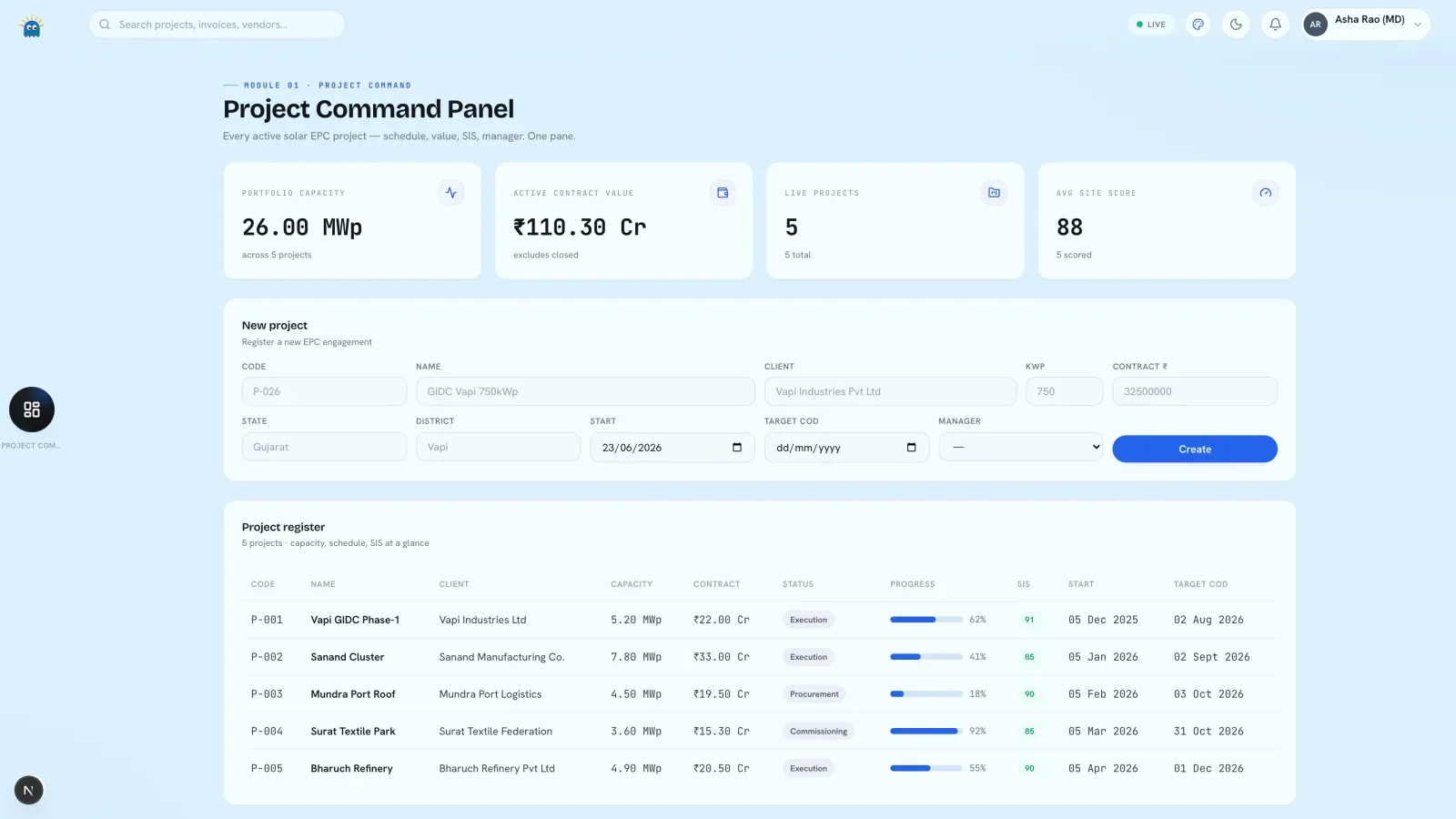
Baxtage is a Mumbai software studio. What exists is SoftSol, an operating system for solar EPC firms, in daily use inside one live EPC.
The thesis follows: operations software for a vertical is best built by someone who runs the operation, and a small, AI-native team can now carry it to market without a large payroll.
Mumbai · Dubai · London · Bootstrapped by default · Memo on request
Status
Where the company stands today.
| Entity | Sole proprietorship, Mumbai. Baxtage Private Limited is being prepared for incorporation. |
|---|---|
| Deployment | One. SoftSol in daily use at a solar EPC where the founder is CTO, a related party. |
| Revenue cleared | None. No signed contracts, and no customers beyond that deployment. |
| Pricing | Not published; scoped on a call. Every call to action is a demo. |
| Team | Two founders and two team members. Salaried payroll begins with incorporation. |
| Capital raised | None. No outside holder of any kind. |
The founders
Founder, CEO and CTO
Mumbai · Dubai
Owns product, engineering and sales. Wrote SoftSol inside the EPC while running its technology, and now sells it to firms like it.
Co-founder and COO
Mumbai · London
Owns operations and partnerships: the pipeline, the relationships that turn a first conversation into a signed scope, and the company's administration.
Three advantages
Each advantage makes the next more valuable.
Depth inside a live operation
SoftSol was built inside a working solar EPC while it ran real projects. Inventory, workforce, machinery, purchase orders, GST invoicing and site reporting were modelled on the work itself, then corrected by the people doing it. A better-funded competitor would still have to earn that data one deployment at a time.
AI-native cost base
AI runs across the build pipeline, from code to copy to video. A product that would once have needed a funded team of fifteen was built by a handful of people, which changes what counts as a viable customer count, price and time to profit.
Operator and builder
The founder runs technology inside a solar EPC and sells software to solar EPCs. He knows which reports an MD reads on a Sunday and which fields a site supervisor will not fill in. That judgement cannot be hired, and it makes a young company credible to EPC directors.
Revenue architecture
Five lines, in order of priority. The first two exist today; the rest are sequenced behind them.
Recurring, per firm. Each solar EPC runs its own tenant, licensed per firm rather than per seat, which is how Indian mid-market operators prefer to buy.
Cash now, productised. Decks, launch sites, brand systems, web apps and automation agents, delivered in days on the pipeline that builds SoftSol, funding the company before software revenue does.
Sequenced. Recurring and sticky. Automation agents built into a client's operations and run on a monthly retainer; switching cost rises every month the agent runs.
Sequenced. A strong margin structure. Short-form spots and reels produced through AI generation pipelines, already used for the studio's own brand films. A revision re-renders one beat, so iteration is nearly free.
Later, through the founder's Dubai presence. Large EPCs and Gulf industrial operators tend to license a deployment under their own name rather than buy off the shelf. There is no Gulf entity, only the founder's time in Dubai.
Unit logic
Capital-light by construction: no office, no hardware, and payroll begins with incorporation. The expensive part of SoftSol, authentication, access control, tenant-scoped data and billing, is already built and already reused by the accounting engine in the Lab, so a new product inherits the hard parts on day one.
Operations software retains differently from marketing software. Once a firm's inventory carries SoftSol QR codes, its invoices are generated inside the platform and its site reports are read from it, leaving means re-keying the business.
The structural margin target is 40–55% net. Internal models show more, but only on a founder draw far below a real salary; the external figure is the one a normal salary structure supports.
Sequence
A phase begins only when the previous one has produced paying customers and cleared cash. The company's failure mode was running many things at once; the cure is order.
Phase 1
SoftSol sold to paying solar EPC firms beyond the founder's own, with studio cash and video funding the company meanwhile.
Phase 2
Licensed deployments for larger EPCs and industrial operators, run through the founder's Dubai presence, under the customer's name where needed.
Phase 3
The same platform into other operations-heavy industries, where a firm runs projects, crews, machinery and invoices on chat threads and spreadsheets.
Risk register
A founder who cannot name the risks cannot manage them.
Founder bandwidth
The founder is also CTO of the EPC and splits his time between two cities.
Mitigation. A co-founder and COO who holds operations and partnerships, two team members on build and operations, and a rule that caps work in flight at three.
Concentration
Every piece of product proof today comes from one firm, and the founder helps run it.
Mitigation. The first paying customer outside that firm is Phase 1's only objective; until then the deployment is a working demo, not proof of demand.
Adoption in an offline-first industry
The buyer is used to chat threads and spreadsheets, and has no reason to trust a young software company.
Mitigation. A working deployment rather than slides, in-person onboarding, import from the spreadsheets and Tally files firms already keep, and a field app that asks for less.
Commoditisation of AI-native services
Services priced only on being cheapest have no floor, and the field grows more crowded every month.
Mitigation. The studio owns a vertical product with operating data behind it, and prices its services on speed and ownership, not on being cheapest.
Use of capital
Bootstrapped by default, unless capital demonstrably shortens one of the following. No amounts are stated.
Complete the hosted database migration so the product runs for any firm, anywhere, with the tenant isolation it has today.
Two to three builders and one operator, so studio and video work ship alongside SoftSol sales rather than after them.
Hands-on deployment at the first paying EPC firms, including import from Tally and Excel, because the first installs must be done in person.
Model credits, voice licensing and a library of brand-locked reference assets, so the first client spots ship at full quality.
Company formation, GST registration, trademarks and the contracts that let invoices be raised cleanly.
Who we want to hear from
A few people, not a large round: operators and angels who know Indian solar EPC and can open doors to firm owners; people with standing among Gulf industrial operators; and D2C founders who need advertising faster than a shoot allows. The best version of this starts with a customer introduction, not a cheque.
Write to the founders directly. The memo covers pipeline, pricing, roadmap and the cap table, shared under NDA. Aditya Shah, Mumbai and Dubai; Rakshit Jain, Mumbai and London.